Sunday, October 19, 2014
Ba Da Ba Ba Ba i'm lustin' it
Source: http://www.adglitz.com/2010/08/mcdonald-ad-slogans-taglines-advertising-over-the-years-commercials-from-1970-1980-1990-2000/
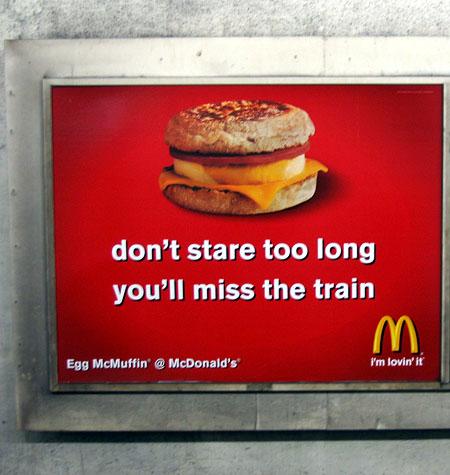
Denotative examination: This is a McDonald's billboard advertising its Egg McMuffin product. The design is simplistic, using a solid red background, a picture of the sandwich, and a humorous message underneath. "Don't stare too long, you'll miss the train" references the poster location, a train station in the city. By saying this, the ad is implying that the picture of the sandwich is so enticing, that you might get distracted by it and miss the train.
Connotative examination: The message that the billboard conveys makes use of the deadly sin "lust." Lust is a strong desire for something, whether it be a person or an Egg McMuffin.The creator of this poster used a suspiciously photogenic sandwich to tempt the viewers and make them desire the product enough to buy it. The text also contributes to the message, suggesting that the audience is so taken aback by the beauty of this breakfast sandwich that they might forget what they were doing. At a glance, this ad might look harmless to its viewers, but in reality McDonald's is really EGGing them on.
Intended audience: Because the advertisement was posted in a train station, everyone riding the trains could see it. Of those people, McDonald's is most likely appealing to commuters riding the train to work or back home. These people are mostly middle class because they are using public transport instead of a private car. McDonald's food can be taken to go as well, providing a cheap, quick, and handheld meal for the working class. The age of this demographic could hover around early twenties college students to mid-fifties employed individuals.
Sunday, October 5, 2014
Life's Unfair for Jane Eyre :'(

("Jane Eyre Memes | Quickmeme." Quickmeme. Web. 5 Oct. 2014.)
2. How would you best describe the central idea of this chapter? Which phrase from the chapter best helps develop the central idea?
Chapter 7 of Jane Eyre begins with Eyre describing her stay at Lowood, an institution for orphans. Life at Lowood is miserable and uncomfortable for the girls. They are not given proper clothes or food, specifically during the winter months. There is heavy emphasis on Christianity at the institution and it is cited as the reason that the girls are not awarded any luxuries. Mr. Brocklebridge, the overseer, scrutinizes the behavior of all the children in an antagonizing manner.
The central idea of this chapter is to demonstrate the poor living conditions at Lowood and how religion is used as a way of manipulation instead of hope. Bronte goes into detail about the hardships the girls go through, from frostbitten extremities to competition for food as a result of malnourishment. Bronte also depicts the antagonist, Brocklebridge, as a cruel man who rules over the women and children despotically. He restricts the food intake of the children and demands that they present themselves modestly, even if that means disregarding natural appearance. The phrase which best develops chapter 7's central idea is a quote by Brocklebridge. He asserts, "Oh, madam, when you put bread and cheese, instead of burnt porridge, into these children's mouths, you may indeed feed their vile bodies, but you little think how you starve their immortal souls!" (Bronte Ch.7). In this quote, he insists that denying the girls proper food is a sacrifice for God, making it essential that they suffer. The institution is hiding behind religion as an excuse for depriving the orphans of what they need to survive.
Subscribe to:
Posts (Atom)
